
Makki and Madani in Ulum al-Quran: Meaning, Characteristics, and Its Branches
Backed by a network of 5,000+ Quran and Arabic teachers, graduates of selective campuses, trained in the Arabi Method.
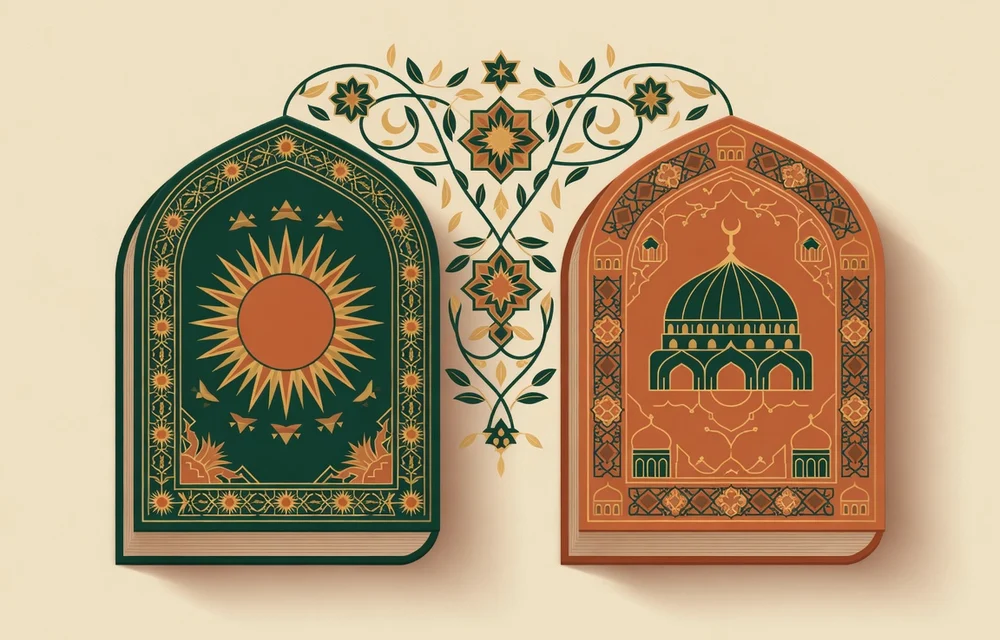
Makki and Madani are classifications of Quranic verses or chapters based on the time of their revelation. According to the strongest view, Makki refers to what was revealed before the Prophet's migration to Madinah, while Madani refers to what was revealed after the migration, even if revealed within Makkah itself.
The Place of Makki and Madani in Ulum al-Quran
Ulum al-Quran is the body of sciences that examines everything connected to the Quran: its revelation, ordering, recording, recitation, interpretation, and inimitability. Among the most fundamental branches of Ulum al-Quran is the science of Makki and Madani, for it serves as the gateway to understanding the context of revelation and the stages of the Prophet Muhammad's mission, peace and blessings be upon him.
Scholars place the science of Makki and Madani in a high rank within Ulum al-Quran. Imam As-Suyuthi in Al-Itqan describes knowledge of Makki and Madani as an essential subject that anyone wishing to interpret the Quran must master, since without it a person may misplace a verse in a context that does not fit its meaning.
By mastering Makki and Madani, you can read the Quran while understanding the flow of the mission: how creed was planted first in Makkah, and how law and the structure of society were then built in Madinah. This understanding nurtures love for the Quran and proper conduct in studying it.
Three Scholarly Perspectives on Defining Makki and Madani
Scholars formulated three main perspectives to distinguish Makki and Madani. The first perspective rests on the time of revelation. According to this view, Makki refers to verses revealed before the Prophet's migration to Madinah, and Madani refers to verses revealed after the migration, even if revealed in Makkah, such as verses revealed during the Conquest of Makkah or the Farewell Pilgrimage. This view is considered the strongest and the most widely held because it is precise and covers every case.
The second perspective rests on the place of revelation. According to this view, Makki refers to what was revealed in Makkah and its surroundings such as Mina, Arafah, and Hudaybiyyah, while Madani refers to what was revealed in Madinah and its surroundings such as Quba and Uhud. The weakness of this view is that it omits verses revealed outside these two cities, such as those revealed during travel or in another land.
The third perspective rests on the audience addressed. According to this view, Makki refers to what addresses the people of Makkah, marked by the expression yaa ayyuhan-naas, meaning O mankind, while Madani addresses the people of Madinah, marked by yaa ayyuhal-ladziina aamanuu, meaning O you who believe. This view serves as a helpful sign, yet it does not hold absolutely because exceptions exist in both.
Among these three perspectives, scholars of Ulum al-Quran favor the perspective of the time of revelation because it offers a consistent distinction applicable to every verse. The other two perspectives remain useful as supplements and helpful indicators in examining Makki and Madani.
Dividing Verses by Time and Place of Revelation
Holding to the strongest view based on the time of revelation, the Quran divides into Makki and Madani verses according to the boundary of the migration. Most chapters in the Quran are Makki because the Makkan period lasted around thirteen years, while the Madinan period lasted around ten years until the passing of the Prophet.
Scholars also recorded special phenomena to understand Makki and Madani with greater precision. There are Madani chapters that contain Makki verses, and conversely there are Makki chapters that contain Madani verses. For this reason the status of a chapter is often named according to the majority of its content, while certain verses within it may carry a different status.
Scholars further mention unique categories, such as a verse revealed in Makkah yet ruled Madani, a verse revealed in Madinah yet ruled Makki, a verse revealed at night, a verse revealed in daytime, a verse revealed while resident, and a verse revealed during travel. These categories reflect the great care scholars devoted to preserving the science of the Quran.
This mapping helps you realize that revelation came down following the real needs of the mission. The long Makkan period planted faith deeply, while the Madinan period built legal and social order in detail. The balance of these two periods is what shaped the Quran as a complete guide for life.
Characteristics of Makki Surahs
Makki surahs carry a distinctive thematic character. Their central theme is the planting of the creed of monotheism, the affirmation of the oneness of Allah, the establishment of prophethood, and belief in resurrection, Paradise, and the Fire. The Makkan period was the era of building the foundation of faith before legal rulings were established, so its verses stir the heart and mind of mankind toward submission to Allah.
In terms of style, Makki surahs generally feature short verses and chapters, strong rhythm, and firm, stirring expression. Many Makki surahs open with the disconnected letters such as Alif Lam Mim and Qaf, with the exception of Al-Baqarah and Ali Imran, which are Madani. The call yaa ayyuhan-naas is frequently found in Makki surahs.
Another characteristic mentioned by scholars: every surah containing a verse of prostration is Makki, every surah mentioning the story of Prophet Adam and Iblis is Makki with the exception of Al-Baqarah, and every surah containing the word kallaa is Makki. Likewise the stories of the prophets and earlier nations are often presented in Makki surahs as a lesson for the polytheists of Makkah.
When you read the short surahs in the final part of the mushaf, you will feel this Makki character clearly. Their verses touch upon the majesty of Allah, the resurrection, and the recompense for deeds. This is how the Quran builds faith from its roots before the detail of rulings is revealed.
يَا أَيُّهَا النَّاسُ اعْبُدُوا رَبَّكُمُ الَّذِي خَلَقَكُمْ وَالَّذِينَ مِنْ قَبْلِكُمْ لَعَلَّكُمْ تَتَّقُونَ
Yaa ayyuhan-naasu'-buduu rabbakumul-ladzii khalaqakum wal-ladziina min qablikum la'allakum tattaquun
O mankind, worship your Lord who created you and those before you, that you may become righteous.
Characteristics of Madani Surahs
Madani surahs reflect the needs of the Muslim community already formed in Madinah. Their central theme is the detailing of legal rulings such as worship, transactions, prescribed punishments, inheritance, struggle in the path of Allah, and the regulation of family and society. After the creed was firmly planted in Makkah, the law was built in Madinah to organize the life of the community in full.
In terms of style, Madani surahs generally feature long verses and chapters with detailed legal exposition. The call yaa ayyuhal-ladziina aamanuu appears frequently in Madani surahs because those addressed are people who already believe. Discussion of the People of the Book, namely the Jews and Christians, and invitations to dialogue with them are also a Madani characteristic.
Another characteristic mentioned by scholars: every surah that mentions permission for struggle in the path of Allah or discusses its rulings is Madani, and every surah that mentions the hypocrites is Madani with the exception of Al-Ankabut, whose opening is Makki. Discussion of the hypocrites arose because hypocrisy only appeared after Islam grew strong in Madinah.
When you examine the long surahs at the beginning of the mushaf such as Al-Baqarah, An-Nisa, and Al-Maidah, you will find the Madani character pronounced. Their verses explain the rulings of prayer, charity, fasting, pilgrimage, trade, marriage, and inheritance in detail. This is the stage when the law organizes the life of the community completely.
يَا أَيُّهَا الَّذِينَ آمَنُوا كُتِبَ عَلَيْكُمُ الصِّيَامُ كَمَا كُتِبَ عَلَى الَّذِينَ مِنْ قَبْلِكُمْ لَعَلَّكُمْ تَتَّقُونَ
Yaa ayyuhal-ladziina aamanuu kutiba 'alaikumush-shiyaamu kamaa kutiba 'alal-ladziina min qablikum la'allakum tattaquun
O you who believe, fasting is prescribed for you as it was prescribed for those before you, that you may become righteous.
How Scholars Identify Makki and Madani
Scholars followed two paths to determine the Makki or Madani status of a verse or chapter. The first path is transmission, namely reliance on sound narration from the Companions who witnessed the revelation, or from the Successors who received this knowledge directly from the Companions. This is the primary and strongest path, since the time and place of revelation are matters that must be received through transmission.
The second path is analogy and examination of characteristics, namely concluding the status of a verse through the signs that scholars formulated. For example, if a chapter contains dominant Makki traits such as stories of earlier nations, short verses, and the call yaa ayyuhan-naas, scholars tend to classify it as Makki. This path is used when narration is not decisive, and it remains guided by the path of transmission.
The Companions devoted great attention to this science. It is narrated that Abdullah ibn Masud, may Allah be pleased with him, knew the place and the reason for the revelation of the verses of the Quran, so the generations after him inherited this precision in preserving Makki and Madani.
Because the path of transmission is the primary foundation, scholars stress the importance of referring to sound narration and reliable works. You are encouraged to place the outward traits of a verse under the guidance of trustworthy narration, then to conclude its status calmly and carefully once the two are brought together.
وَاللَّهِ الَّذِي لَا إِلَهَ غَيْرُهُ مَا أُنْزِلَتْ سُورَةٌ مِنْ كِتَابِ اللَّهِ إِلَّا أَنَا أَعْلَمُ أَيْنَ أُنْزِلَتْ وَلَا أُنْزِلَتْ آيَةٌ مِنْ كِتَابِ اللَّهِ إِلَّا أَنَا أَعْلَمُ فِيمَ أُنْزِلَتْ
Wallaahil-ladzii laa ilaaha ghairuhu maa unzilat suuratun min kitaabillaahi illaa anaa a'lamu aina unzilat wa laa unzilat aayatun min kitaabillaahi illaa anaa a'lamu fiima unzilat
By Allah besides whom there is no deity, no chapter of the Book of Allah was revealed except that I know where it was revealed, and no verse of the Book of Allah was revealed except that I know about what it was revealed.
Benefits of Studying Makki and Madani
Studying Makki and Madani yields many benefits in understanding the Quran. The first benefit is aiding correct interpretation. By knowing the context of the time of revelation, you can place a verse upon its proper meaning and avoid an interpretation that exceeds the actual intent. This knowledge becomes an essential tool for the exegetes.
The second benefit is grasping the stages of the mission and the wisdom of gradual legislation. You can see how Allah planted creed first, then sent down rulings in stages according to the readiness of the community. A clear example is the prohibition of intoxicants, which came in stages, an educational wisdom you can emulate in raising your children.
The third benefit relates to the science of the abrogating and the abrogated. To know which verse was revealed earlier and which later, knowledge of Makki and Madani becomes decisive, since a later verse may clarify an earlier one.
The fourth benefit is nurturing certainty in the authenticity of the Quran's preservation, for scholars guarded this science with great precision from the time of the Companions. The fifth benefit is helping callers to Islam grasp the Quran's method of invitation, namely planting faith before burdening the community with rulings, so that the call proceeds with wisdom and in stages.
Related Branches of Ulum al-Quran
The science of Makki and Madani stands among other branches of Ulum al-Quran that complement one another. The first closely related branch is the science of asbab al-nuzul, the science of the reasons for revelation. Many Madani verses were revealed to answer a particular event or question, so asbab al-nuzul clarifies their context.
The second branch is the science of the abrogating and the abrogated, the science of one ruling being lifted by a ruling revealed later. This branch depends on the chronological order of revelation, which is supported by the science of Makki and Madani. The third branch is the science of the order of revelation, the knowledge of the sequence in which chapters were revealed, which refines the mapping of the Makkan and Madinan periods.
Other complementary branches include the science of the clear and the ambiguous verses, the science of recitations, the science of Uthmanic script, the science of the Quran's inimitability, and the science of coherence between verses and chapters. All these branches gather under the umbrella of Ulum al-Quran, and Makki and Madani serve as one of the foundations that support understanding of the other branches.
Understanding the connection of these branches nurtures a complete picture of how rich the treasure of Ulum al-Quran is. Each branch answers a different facet, and the science of Makki and Madani provides the chronological framework upon which the other branches rely when interpreting the Quran accurately.
Common Mistakes in Understanding Makki and Madani
The first mistake is to assume that Makki always means revealed in the city of Makkah and Madani always means revealed in the city of Madinah. The accurate understanding, according to the strongest view, rests on the time of revelation, namely before or after the migration, so a verse revealed in Makkah after the migration, such as during the Conquest of Makkah, remains Madani.
The second mistake is to assume that the call yaa ayyuhan-naas is certainly Makki and yaa ayyuhal-ladziina aamanuu is certainly Madani in an absolute sense. This audience sign holds in general, yet exceptions exist, so it serves only as a helpful indicator that requires the support of narration before being made a firm conclusion.
The third mistake is to conclude a chapter's status from a single verse you read, while a Makki chapter may contain a Madani verse and the reverse. A chapter's status is named according to the majority of its content, while a particular verse within it may differ.
The fourth mistake is to make this science a subject of debate without proper conduct, while scholars discussed it with precision and mutual respect. You are encouraged to refer to reliable works of Ulum al-Quran and to restrain yourself from drawing your own conclusions without knowledge, in order to preserve the honor of the science of the Quran and its people.
Glossary of Key Terms
Here are the key terms that help you understand the discussion of Makki and Madani. Makki: a verse or chapter revealed before the Prophet's migration to Madinah according to the strongest view. Madani: a verse or chapter revealed after the Prophet's migration to Madinah, even if revealed in Makkah. Hijrah: the migration of the Prophet Muhammad, peace and blessings be upon him, from Makkah to Madinah, which serves as the dividing boundary between the two categories.
Asbab al-nuzul: the reasons that underlie the revelation of a verse. Abrogating and abrogated: a ruling that lifts and a ruling that is lifted by a verse revealed later. Order of revelation: the sequence in which the chapters of the Quran were revealed. Disconnected letters: the opening letters of some chapters such as Alif Lam Mim, read separately.
Audience: the addressee or the target of speech in a verse. Clear verse: a verse whose meaning is plain and decisive. Ambiguous verse: a verse whose meaning requires further explanation. Transmission method: the method of identifying Makki and Madani through sound narration. Examination method: the method of identifying Makki and Madani through study of its characteristics.
Conquest of Makkah: the event of liberating the city of Makkah in the eighth year of the migration. Farewell Pilgrimage: the parting pilgrimage that the Prophet performed near the end of his life. Understanding this glossary makes it easier for you to study works of Ulum al-Quran with greater confidence and to place each term upon its proper meaning.
Frequently Asked Questions
What is the strongest definition of Makki and Madani?
Is a Madani surah always revealed in the city of Madinah?
How can I recognize the characteristics of a Makki surah?
What is the main characteristic of a Madani surah?
Why is it important to study Makki and Madani?
How do scholars determine the Makki or Madani status of a verse?
How does Makki and Madani relate to other branches of Ulum al-Quran?
Sources and references
- Al-Itqan fi Ulum al-Quran , Jalal al-Din al-Suyuti
- Mabahith fi Ulum al-Quran , Manna al-Qattan
- Al-Burhan fi Ulum al-Quran , Badr al-Din al-Zarkashi
- Manahil al-Irfan fi Ulum al-Quran , Muhammad Abd al-Azim al-Zarqani
Other Arabi Guides
 Quran Recitation
 What Is the Ideal Age for a Child to Start Learning to Recite the Quran?
The ideal age to start learning to recite the Quran is around 4 to 6 years, through a joyful introduction to the hijaiyah letters. Read Arabi's age-by-age guide for every age.
Read article Teachers
 How to Choose the Right Quran Teacher for Your Family
A guide to choosing the right Quran teacher: the teacher's expertise and educational background, patience in teaching, fit with the student, and a clear method. For all ages.
Read article Tahfidz
 A Memorisation Method That Lasts: How Quran Hifz Stays Firm
A guide to a Quran memorisation method that lasts: talqin, staged review, and muroja'ah with the sabaq, sabqi, manzil system. How hifz stays firm, for all ages.
Read articleReady to Begin Learning with Arabi?
Expert teachers are ready to guide you, one on one, online or in person. Free consultation, no commitment.