

Adapts to Your Pace
Every student has their own tempo. The teacher adjusts speed, repetition, and difficulty to your current ability, so learning feels right and comfortable at your own pace.
The Arabi method brings together the best ways to learn, from the centuries-old talaqqi tradition to modern educational research, into one complete path. With more than 5,000 expert teachers, every student is guided one on one at a pace that matches their ability, at home or online.
The Arabi method is Arabi's own way of learning the Quran and Arabic, synthesized from the best classical and modern methods. Students read directly from the sounds without spelling, are corrected on the spot by a teacher, and advance only after they are truly fluent, at a pace that matches each person's ability.
The Arabi method rests on six principles that reinforce one another, drawn from the best classical and modern ways of learning.
Every student has their own tempo. The teacher adjusts speed, repetition, and difficulty to your current ability, so learning feels right and comfortable at your own pace.

Recitation is learned face to face with a teacher who listens. Every mistake is corrected right then, the way the Quran has been passed down since the first generation.

Students read directly from the sound of each letter, without spelling letter by letter. This helps students become fluent faster, in line with proven modern reading methods.

Each level is checked through munaqasyah, measured by fluency, speed, accuracy, and correct articulation. Students advance after true mastery, so the foundation stays strong.

Reading and memorization are reviewed regularly at set intervals so they stick and stay, in line with how human memory works.

Worksheets, articulation diagrams, example words from the Quran, and color coding for recitation rules make every concept easy to understand and remember.
Before designing its own method, Arabi studied the proven methods of Quran reading, tahfidz, and Arabic, then took the strength of each.
Learning face to face with a teacher who listens, the way the Quran has been passed from one generation to the next. This is the heart of every Arabi session.
Reading directly from sound without spelling, advancing volume by volume. Arabi strengthens this with worksheets and articulation diagrams.
Reading with rhythm and timing that keep the lengths of recitation accurate. Arabi adds graded munaqasyah to assess the quality of recitation.
Reading, writing, and memorizing in careful Uthmani script, compiled by the family of KH Arwani Amin and published in 2004. Arabi preserves this care in writing.
Learning Arabic from examples and patterns, paired with four-skill conversation. Arabi makes it easier with full vowel marks, word icons, and color-coded i'rab.
Learning each stage to mastery, reviewing at intervals, and strengthening memory by reciting back. Arabi weaves these together with good character and personal guidance.
From all of this heritage, Arabi built one complete method, then tailored it to the learning pace of each student.
The same principles are applied with steps tailored to Quran reading, Arabic, tahfidz, and tahsin.

From zero to reading the mushaf fluently
Letters are introduced directly with their sounds and correct articulation points, without spelling them out.
Students imitate the teacher's recitation, then repeat together and one by one until the tongue is at ease.
Letters and words are read in random order to make sure students are truly reading each one, with the sequence changed every time.
From single letters, connected letters, vowels, tanwin, and sukun, to tajwid rules and on to real verses of the mushaf.
Before advancing, recitation is tested for fluency, speed, accuracy, and correct articulation.

A next-generation Durusul Lughah, easier to understand
Rules are introduced through examples and practice first, with explanation following, in the inductive style of the Madinah books.
Every word carries full vowel marks and a simple picture, so it is easy to read and remember from the start.
The words studied favor those that appear often in the Quran, with a verse window as a real example.
Word functions such as mubtada, khabar, fi'il, and fa'il are distinguished by color, then practiced by their marks and roles.
Material is reviewed at set intervals, then used in short conversation so it sticks and comes alive.

Memorization that sticks and is mutqin
The teacher recites the verse, and the student imitates repeatedly until it is correct before memorizing.
New memorization is added little by little according to ability, with recitation that is already correct.
Recent and older memorization are reviewed regularly so they are preserved.
Students recite their memorization to the teacher to be corrected and confirmed accurate.
Memorization is cared for with regular muraja'ah until it is firm, lasting, and preserved.

Refining recitation until it is correct and beautiful
The point each letter comes from is corrected one by one by listening directly to the teacher.
Qualities of each letter such as heavy, light, and the bounce of qalqalah are practiced so the sound is precise.
Idzhar, idgham, iqlab, and ikhfa are learned through examples and marked with color.
The lengths of recitation and the places to stop are practiced according to tajwid rules.
Once recitation is correct, the melody of tilawah is shaped so it sounds beautiful and calming.
Genuine excerpts from the Arabi Volume 1 workbook, from the articulation map to the practice sheet, all arranged neatly and measurably.
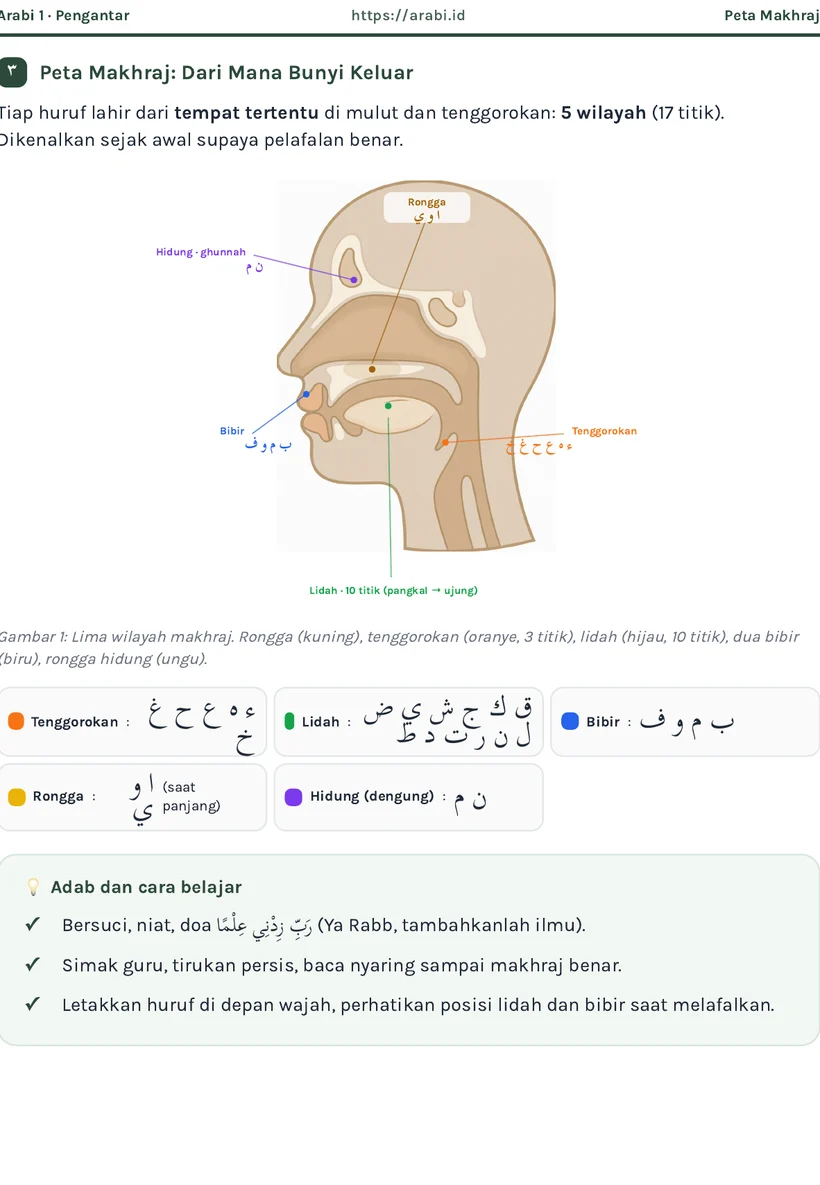
The five regions where letters come from, introduced early so pronunciation is correct.
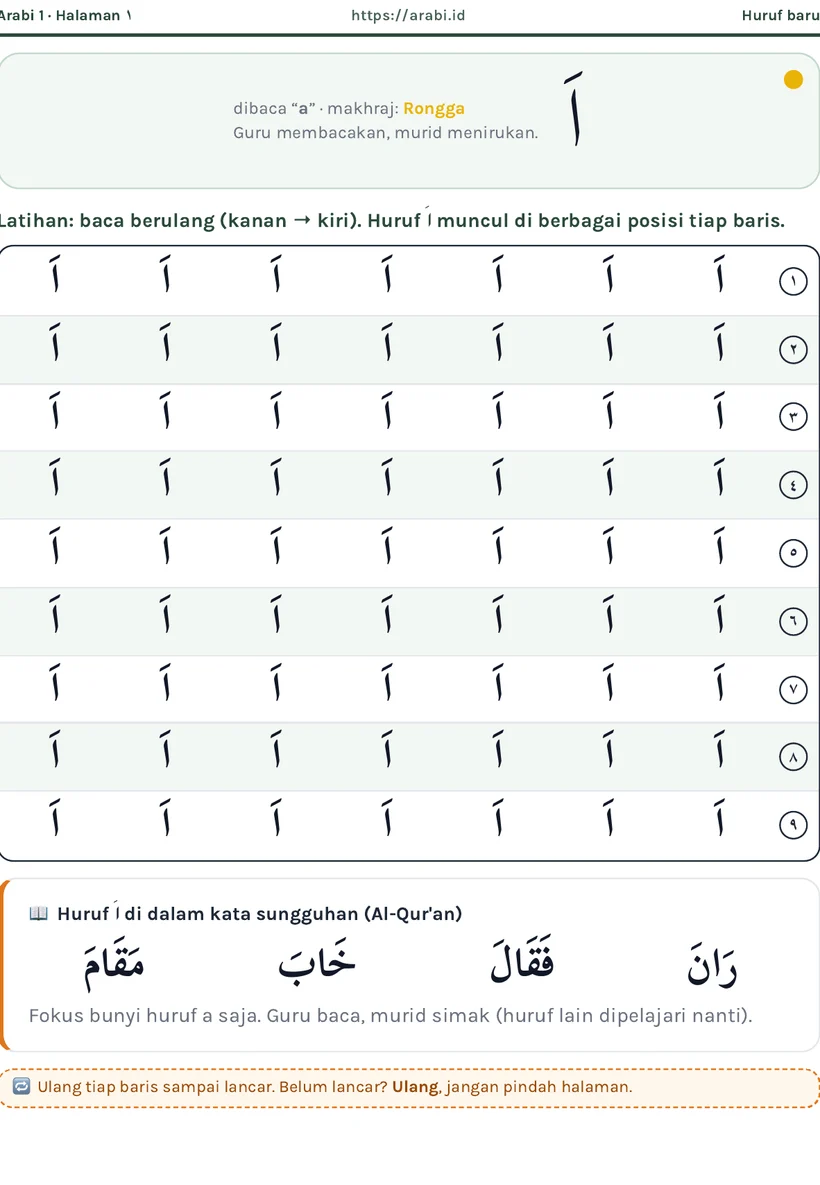
Each letter is introduced with its sound and articulation, then appears in a real Quranic word.
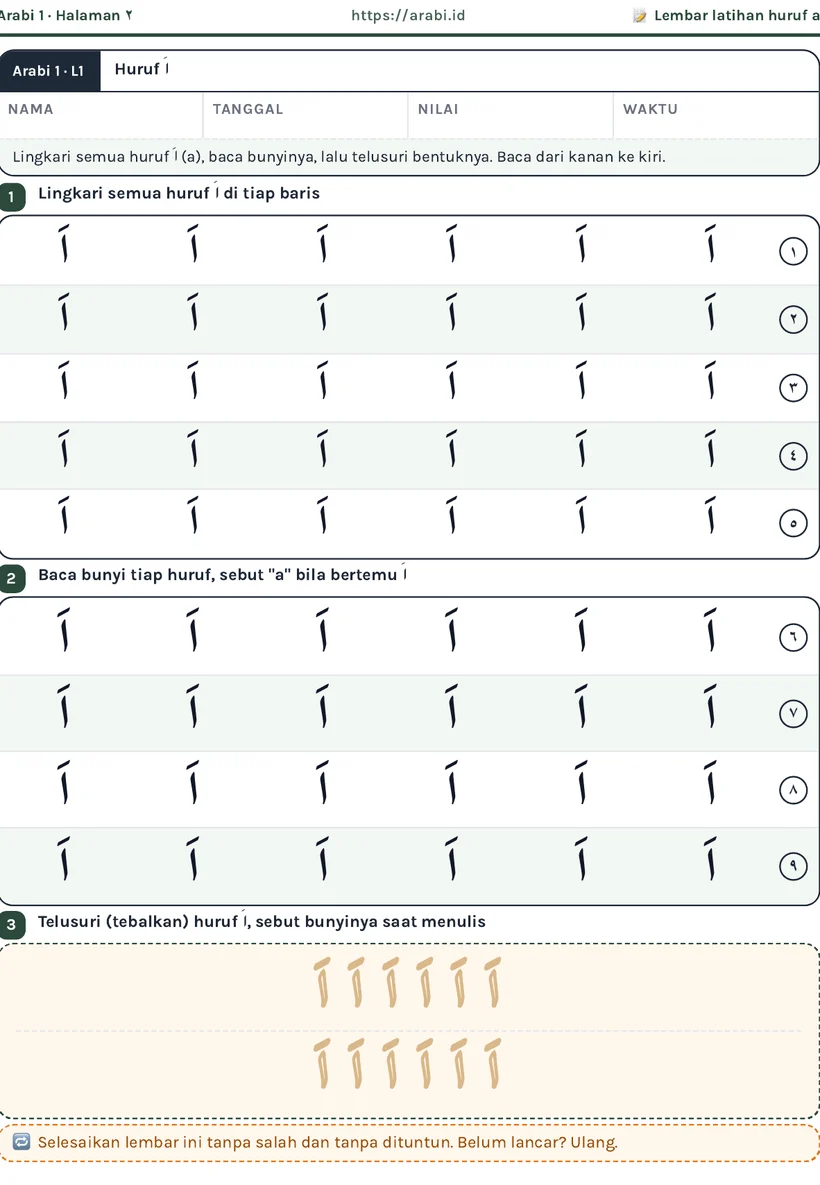
A structured worksheet to circle, read, and trace the letter until fluent.
Excerpts from the printed Arabi material, with its Quranic text already verified for accuracy.
Some students grasp the letters quickly, others need more time for each reading. The Arabi method honors both.
With one-on-one private lessons, the teacher sets the tempo, repetition, and difficulty to the student's ability at the time. Students advance when they are ready, with a strong foundation.
The teacher assesses your starting ability, then places you at the right level, from zero or continuing.
Harder parts are repeated more, parts already mastered are covered more briefly.
Munaqasyah makes sure you are fluent before advancing, so each stage stands on the one before it.
The Arabi method orders the journey from recognizing letters to memorization, one level above the next.
From iqra to tahfidz
Every level is matched to your starting ability, children and adults alike.
An honest comparison between learning with the Arabi method and a few other common ways.
| Aspect | The Arabi Method | Self-Study | Large Open Class |
|---|---|---|---|
| Learning pace | Adapts to each student | Depends on self-discipline | Follows the class tempo |
| Reading correction | Direct each session by a teacher | Often goes undetected | Limited because of many students |
| Advancing levels | After munaqasyah, measurable | Without a clear measure | Follows the class schedule |
| Materials | Gradual, rich, from the real Quran | Varied and uncertain | Uniform for everyone |
| Way of learning | Private at home or online | On your own | Coming to one place |
Supported by thousands of teachers across many cities, the Arabi method can run in the way that is most comfortable for you.

An Arabi teacher comes to your home and teaches privately one on one, comfortable and personal.

Learn via video call with a teacher, flexible from anywhere.

Learn together with two to five students in an encouraging atmosphere.
Access materials and track progress through Arabi App, Arabi's digital learning platform.
 Start Today
 A free consultation to find the right level and way of learning for you or your child.