Arabi's tahsin course in Malang is for you who can already read the Quran and long for a recitation that is truly clean. The makhraj, the place from which every letter comes out, is fixed at its root, the quality of each letter is set firm, and the rules of tajwid are polished by an ustadz or ustadzah in private one-on-one sessions. Learn at home across Malang, from Klojen to Sawojajar, or online, whether you are a teenager, an adult, or a senior.
Listened to DirectlyYour recitation corrected as you read
368+Teachers serving Malang
Private 1 on 1Every session focused on your recitation
2 WaysAt home in Malang and online
4 StagesA measured climb from makhraj to tilawah
Listened to DirectlyYour recitation corrected as you read
368+Teachers serving Malang
Private 1 on 1Every session focused on your recitation
2 WaysAt home in Malang and online
Quick Answer
What is the Quran tahsin tilawah course at Arabi in Malang?
The Arabi Method for Tahsin and Tilawah in Malang guides students step by step, from the basics to lasting ability, with the support of an ustadz or ustadzah who adapts to the needs of Malang families, from the Dinoyo campus area to the Sawojajar neighborhood.
Key points
Made for readers in Malang who want their recitation to be cleaner.
Four stages that set right makhraj, letter qualities, tajwid, then tilawah.
Your recitation is heard and corrected by the ustadz through talaqqi as you read.
It opens with a recitation assessment that maps the points needing work.
Quick facts
Stages
4 stages of improvement
For
Those who can already read
Format
Private one-on-one
How to learn
At home in Malang and online
What It Is
What is Tahsin Tilawah in Malang?
Tahsin and Tilawah in Malang with Arabi is a structured path of Islamic education for children and families across all corners of Malang, from Klojen and Lowokwaru in the city center to Blimbing, Sukun, and Kedungkandang.
Fixing the makhraj, the place each letter comes from, so letters with similar sounds stay apart.
Setting firm the qualities of letters such as qalqalah, hams, jahr, and isti'la in every recitation.
Polishing the rules of tajwid, from nun sukun, mim sukun, and mad to ghunnah, through real verses.
Reading with a calm tartil, then meeting the beauty of tilawah one step at a time.
Learning Map
The Stages of Tahsin, from Fixing Sounds to Tilawah
Four steps in sequence that build one upon another. You begin from your assessment result, then rise once the stage before it reads clean.
Stage
1Makhraj in PlaceFixing the point of articulation of each letter and drilling letters of close sound separately, until their sounds stand precisely apart.
2Qualities of Letters Set FirmSetting firm the quality of each letter, such as qalqalah, hams, jahr, and isti'la, so each one is read with the correct trait.
3Tajwid PolishedLaying on the rules of nun sukun, mim sukun, ghunnah, and the kinds of mad step by step through real verses, until the application stays consistent.
4Tartil and TilawahShaping the pace into a calm tartil with correct waqaf and ibtida, then meeting the smoothness of tilawah.
Each stage opens with an example from the ustadz, then guided practice, then repetition until the right pattern settles in.
Comparison
An Honest Comparison of Arabi's Private Tahsin
Many parents in Malang weigh various ways for their children to learn recitation and Arabic. Here is an honest picture of how structured Tahsin and Tilawah with Arabi helps families in Malang compared with other options, with student progress you can follow from meeting to meeting. The heart of tahsin is that your recitation is heard and the wrong habits are corrected by an ustadz. Weigh a few ways of improving recitation honestly so you can choose the best path for you in Malang.
Catching wrong habits
Arabi Private Tahsin
Recitation heard in full and mapped through an assessment
Learning from VideosHard to catch your own mistakes
Group Tahsin Study CirclesRests on the teacher's attention to each participant
Fixing the makhraj
Arabi Private Tahsin
Fixed from the point of articulation of each letter
Learning from VideosNo listener to correct it as you go
Group Tahsin Study CirclesTurns for correction are short with many participants
Setting letter qualities firm
Arabi Private Tahsin
Drilled one by one until told apart
Learning from VideosHard to judge without a guide
Group Tahsin Study CirclesRests on the correction time on hand
Pace of improvement
Arabi Private Tahsin
Fitted to each student's ability
Learning from VideosRests on your own discipline
Group Tahsin Study CirclesFollows the pace of the class
Progress reports
Arabi Private Tahsin
Regular reports on the points that read clean
Learning from VideosYou keep track of it yourself
Group Tahsin Study CirclesRests on the organizer's policy
Pricing
Tahsin and Tilawah Cost in Malang
This fee is the same for every Arabi teacher serving Malang and its surroundings, including Klojen, Lowokwaru, Blimbing. You are free to learn privately at home or online.
A1Foundational (introduction)Rp 55.100 / per session
A2Foundational (advanced)Rp 63.365 / per session
B1IntermediateRp 72.870 / per session
B2Intermediate (advanced)Rp 83.800 / per session
C1AdvancedRp 96.370 / per session
C2ProficientRp 110.826 / per session
Take a package, and the larger it is the more you save per session:
4 sessionsRp 73.000 per sessionRp 292.000
8 sessionsRp 70.000 per sessionRp 560.000
12 sessionsRp 68.000 per sessionRp 816.000
24 sessionsRp 65.500 per sessionRp 1.572.000
A single session: Rp 72.870 in person, Rp 55.100 online.
Ustadz and Ustadzah Who Listen Closely to Your Recitation
Arabi's tahsin teachers for Malang are experts in tajwid and Arabic, chosen through a selection across campuses and universities, then trained to the standard of the Arabi Method. Their grounding brings proven skill, close attention to makhraj and letter qualities, and the sincerity of a teacher who guides with good manners and patience, at ease with the rhythm of a study city like Malang.
A
Attentive to Makhraj and QualitiesNational network
Listens to your recitation keenly, catching a shifted makhraj and a missed letter quality, then fixes it with a clear example.
Makhraj of letters
Qualities of letters
Tajwid
T
Trained in the Arabi MethodCampus graduates
Knows the flow of the four stages of tahsin, the ways of musyafahah and talaqqi, and how to build an improvement map from the recitation assessment.
The Arabi Method
Recitation assessment
Talaqqi
P
Patient in Setting Habits RightAt home in Malang and online
Guides with patience when setting right habits that have long taken root, fitting the pace for adults and seniors alike.
Adult mentoring
Guided tikrar
Manners of learning
Real Arabi Teachers
Ustadz Who Teach Tahsin and Tilawah in Malang
A glimpse of the real Arabi teachers who guide Tahsin and Tilawah in Malang, chosen from leading campuses and trained in the Arabi method.
RUIN
Ustadz Randi A.
Universitas Islam Negeri Syarif Hidayatullah JakartaIlmu Hadits
Memperbaiki bacaan santri satu per satu, sehingga setiap pertemuan terasa makin lancar dan percaya diri. Latar pendidikannya di UIN memperkuat cara ia mendampingi santri belajar.
Mengaji Al-Quran
Tafsir
Studi Islam
NUIN
Ustadzah Nurul/Laila L.
UIN Sunan KalijagaHukum Ekonomi Syariah
Mengajar mengaji dengan runtut, dari mengenal harakat sampai membaca ayat dengan tajwid yang benar. Bahasa Arabnya membantu santri memahami makna yang dipelajari. Latar pendidikannya di UIN memperkuat cara ia mendampingi santri belajar.
Mengaji Al-Quran
Tahfidz
Bahasa Arab
Studi Islam
FPesantren
Ustadz Fakhri K.
Pondok Pesantren La Tansa 2
Mengajak santri akrab dengan bahasa Arab lewat percakapan dan kosakata sehari-hari, lalu menapak ke kaidah. Suasana belajarnya hangat dan menyenangkan.
Bahasa Arab
Mengaji Al-Quran
Tahsin Tajwid
Studi Islam
HDarussalam Gontor
Ustadz Hasan B.
Universitas Darussalam Gontor
Melatih santri menggoreskan khat dengan seimbang dan rapi, dari huruf tunggal sampai rangkaian yang indah. Terbiasa berbahasa Arab sejak di Gontor, ia membuat belajar terasa dekat dan hidup.
Kaligrafi
Bahasa Arab
Mengaji Al-Quran
Studi Islam
These are a few of the teachers; thousands more serve families across Indonesia.
Reviews
Stories from Tahsin Students in Malang
4.9From 34 parent reviews
I have read fluently since I was small, but it turned out many of my makhraj had shifted without me noticing. After joining tahsin, my recitation feels far cleaner and I am calmer when I lead the prayer at the musala near our home in Sawojajar.
I want to teach the children around my neighbourhood, so my recitation had to be correct first. The ustadzah patiently corrected the quality of each letter one by one, and the weekly report lets me see how far I have come.
Online tahsin turned out to work well while I am busy with campus in Dinoyo. The ustadz shows a digital mushaf and still hears my recitation directly, the wrong habits I long carried were fixed little by little, and the evening schedule suits me.
FAQ
Questions about Tahsin at Arabi in Malang
What is the difference between tahsin and an ordinary Quran reading course?
An ordinary Quran reading course is for those who want to learn to read the Quran starting from recognizing the letters, while tahsin is for those who already read and want their recitation cleaner and in keeping with the rules. Tahsin fixes the makhraj, the letter qualities, and the rules of tajwid that often shift unnoticed, then shapes the reading pace into a calm tartil.
I already read fluently, do I still need to join tahsin?
Fluent and clean are two different things. Many who already read fluently still carry a shifted makhraj, a missed letter quality, or rules of tajwid that are not yet consistent. Tahsin helps you find and set right these wrong habits through a recitation assessment, so your recitation reads correctly and is heard clearly.
What is set right in tahsin using the Arabi Method?
Arabi's tahsin sets right four layers in order. First the makhraj, the place each letter comes from. Second the qualities of letters, such as qalqalah, hams, and isti'la. Third the rules of tajwid, from nun sukun, mim sukun, and ghunnah to the kinds of mad. Fourth tartil and an introduction to tilawah, so the recitation stays calm, orderly, and pleasant to hear.
What are the makhraj and the qualities of letters so often mentioned in tahsin?
The makhraj is the place each letter comes from, across five regions: the mouth cavity, the throat, the tongue, the two lips, and the nasal passage. The qualities of letters are the traits carried within each letter, such as qalqalah that bounces, hams that hisses, and isti'la that is raised. Together they keep similar letters, such as sin and shin, precisely apart.
How long does it usually take for recitation to read clean after joining tahsin?
Every student is different, depending on where their recitation starts and how regularly they practice. Setting right habits that have long taken root calls for guided repetition, so the process is gradual. With four stages of improvement and a recitation heard privately each time you meet, many students in Malang feel their reading grow cleaner within a few months, and the regular report helps you see the progress.
Can tahsin be done online for families in Malang?
Yes. Over a video call, Arabi's online tahsin class shows a digital mushaf on the screen together. The teacher keeps listening and then corrects your recitation on the spot, including the makhraj and the letter qualities, and the hours can be set at the most convenient time, including after the maghrib prayer or on Saturday and Sunday, so it stays light for busy families across Malang.
Is tahsin suitable for those who want to become an imam or a teacher?
Very suitable. An imam's recitation reaches many ears and a teacher's recitation becomes an example for their students, so the accuracy of makhraj, the letter qualities, and tajwid matters. Arabi's tahsin polishes this foundation of recitation thoroughly, then shapes the pace into a calm tartil, so you feel more ready and sure when you lead or teach.
Can Tahsin and Tilawah in Malang be learned privately at home?
Yes. Arabi offers Tahsin and Tilawah with the support of an ustadz or ustadzah who can come to your home in various Malang areas such as Klojen, Lowokwaru, Sawojajar, or Kedungkandang, and there is also an online learning option so students stay regular even when family schedules in Malang are full.
What age is suitable to begin Tahsin and Tilawah in Malang?
Children in Malang can begin Tahsin and Tilawah from an early age, and the level is matched to each student's ability. Arabi will help you recognize your child's readiness first so that learning feels comfortable and gradual amid the daily life of families in Malang.
How does Arabi maintain the quality of Tahsin and Tilawah teachers in Malang?
Arabi Tahsin and Tilawah teachers in Malang are ustadz and ustadzah trained in the Arabi Method, graduates of various campuses, with expertise in reading the Quran and Arabic and the heart of a true teacher who teaches sincerely, so your child in Malang is guided with patience and good adab.
Does Arabi reach Klojen and Lowokwaru in Malang?
Yes. Arabi teachers serve families across Malang, including Klojen, Lowokwaru, Blimbing, and other areas. Sessions run privately at your home or online, so Tahsin and Tilawah stays accessible wherever you are in Malang.
Getting to Know Your City
Arabi Tahsin and Tilawah in Malang
Malang is an education city in East Java with a cool climate, where many Muslim families raise their children with the hope of growing up close to the Quran and Arabic. From the city center in the Klojen area, the campus districts in Lowokwaru and Dinoyo near UIN Maulana Malik Ibrahim Malang, to the dense neighborhoods of Sawojajar and Kedungkandang, the atmosphere of religious learning lives on through mosques, madrasahs, Quran learning gardens, and majelis taklim. The Malang region is also surrounded by a strong pesantren tradition, such as in Singosari and Bululawang, so learning Tahsin and Tilawah in Malang feels woven into family daily life, accompanied by ustadz and ustadzah who understand the rhythm of this city.
Malang is known as a student city with many campuses, including UIN Maulana Malik Ibrahim Malang in the Dinoyo area. Amid this academic atmosphere, Tahsin and Tilawah with Arabi helps your child in Malang build a strong foundation in recitation and Arabic with good adab.
Close to the pesantren tradition of Greater Malang
The Malang region is surrounded by long-rooted pesantren and madrasahs, such as in Singosari and Bululawang. The Arabi Method carries on that spirit with structured Tahsin and Tilawah teaching, so students' tajwid and memorization take hold gradually.
Teachers who understand the daily life of Malang residents
Arabi brings ustadz and ustadzah trained in the Arabi Method who are used to accompanying children in city areas such as Klojen, Lowokwaru, and Sawojajar, patiently reading each student's ability and explaining in language that is easy to understand.
Material Preview
Real Tahsin and Tilawah Materials for Students in Malang
A preview of the official Arabi Method modules used in lessons, showing the depth of Arabi teaching materials.
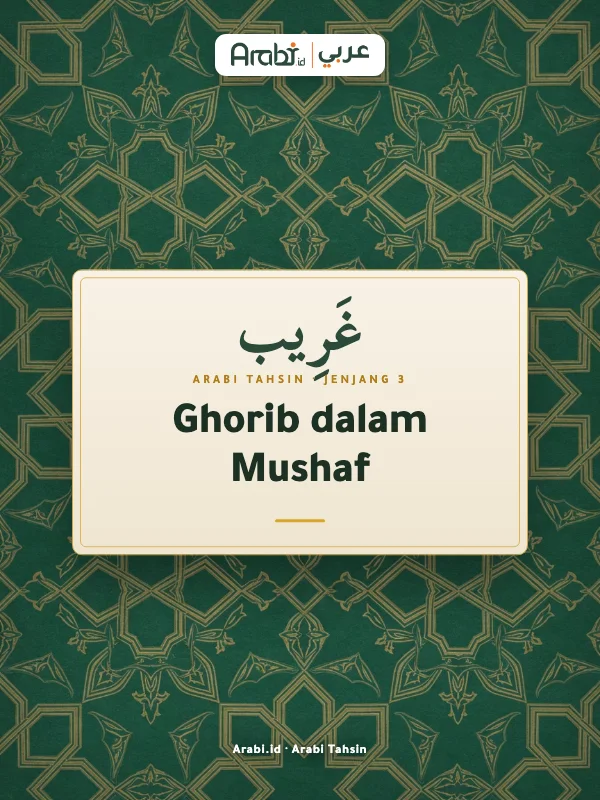
Tahsin 3: Ghorib dalam Mushaf
Real material
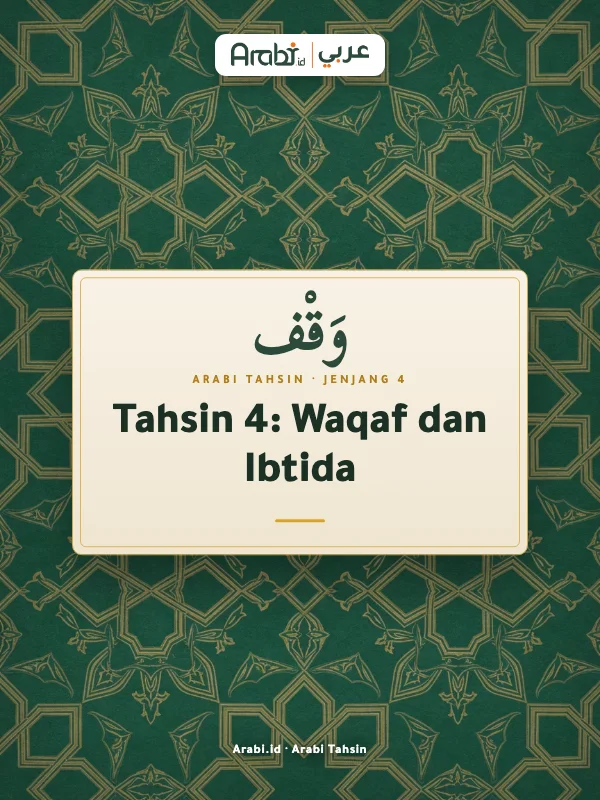
Tahsin 4: Waqaf dan Ibtida
Real material
Tahsin 5: Tartil dan Munaqasyah
Real material
Materials are matched to the level and ability of each student.
Child Readiness
Signs You Are Ready to Begin Tahsin
Before starting Tahsin and Tilawah in Malang, it is good to recognize your child's readiness according to age and ability, so that the learning process amid a student city like Malang feels light and enjoyable for students. Tahsin is built for those who already know the letters and can read. The checklist below gives you a picture before you begin, and the ustadz settles the points to improve through a recitation assessment at the start.
Signs Tahsin Suits You
You can already read the Quran, even if it is not yet clean
You want to fix a makhraj or a point of tajwid that feels lacking
You sense there are letters that often get swapped as you read
What Helps Improvement Come Faster
You can set aside one 60-minute session each week
You are willing to repeat the corrected recitation at home
You are open to setting right old habits that have taken root
What Arabi Provides
A thorough recitation assessment in the first session
A personal improvement map drawn from the assessment findings
A regular report covering the points that already read clean
Inside Tahsin
Four Layers Set Right in Tahsin
The Arabi Method for Tahsin and Tilawah in Malang guides students step by step, from the basics to lasting ability, with the support of an ustadz or ustadzah who adapts to the needs of Malang families, from the Dinoyo campus area to the Sawojajar neighborhood. A clean recitation rests on four layers that hold one another up. Arabi's tahsin in Malang sets them right one at a time.
01
The Makhraj of Letters
The place each letter comes from, across five regions: the mouth cavity, the throat, the tongue, the two lips, and the nasal passage. A letter voiced from the wrong place shifts its sound, so this is set right first.
02
The Qualities of Letters
The traits carried within each letter, such as qalqalah that bounces, hams that hisses, jahr that rings clear, and isti'la that is raised. The right quality keeps letters of a similar makhraj apart.
03
The Rules of Tajwid
The rules for when letters meet, from the rules of nun sukun and tanwin, namely izhar, idgham, iqlab, and ikhfa, then the rules of mim sukun, ghunnah, and the kinds of mad with the length each holds.
04
Tartil and Tilawah
A calm, orderly reading pace that follows the marks of waqaf and ibtida, then the smoothness of tilawah that makes a recitation feel settled, ordered, and pleasant to hear.
Each layer is repeated until it reads clean before you move on to the next.