Learn to read the Quran with one on one guidance. An Arabi ustadz or ustadzah comes to your home or guides you over video call, on a schedule arranged around your family's time. A good fit for a child just learning the letters, busy students and working adults, and seniors who want to read the Quran fluently at any age.
An ustadz or ustadzah matched to each student's needs
Schedule arranged around your family's time, including evenings and weekends
Free consultation before the first session begins
One on OnePrivate Guidance
One on OnePrivate Guidance
Home and OnlineTwo Ways to Learn
Flexible ScheduleAround Your Time
5,000+Quran and Arabic Teachers
All AgesChildren to Seniors
One on OnePrivate Guidance
Home and OnlineTwo Ways to Learn
Flexible ScheduleAround Your Time
5,000+Quran and Arabic Teachers
All AgesChildren to Seniors
What It Is
What is Private Quran Reading Lessons?
Private Quran reading lessons are one student, one teacher guidance in reading the Quran, with an ustadz or ustadzah who comes to your home or teaches over video call. Each session runs 60 minutes, the schedule follows your family's time, and the material adjusts to the student's ability, from children aged 5 to adults and seniors.
Full one on one guidance every session
An ustadz comes to your home or guides you on screen
Schedule arranged around your family's time
Material and pace adjust to the student's ability
Open to children, students, working adults, and seniors
Method
How an Arabi Private Quran Reading Lesson Runs in Your Home
Reading the Quran correctly grows when a student's recitation is heard and corrected right on the spot. In Arabi private lessons, guidance runs through talaqqi, where the student reads and the ustadz listens directly, with the pace following one student entirely. Your child pronounces each letter from its proper makhraj (the point the letter comes from), then reads with calm tartil (measured, unhurried recitation), so good reading habits take shape from the very first session at home.
1
Free Consultation and Initial Reading Assessment
Before the regular sessions, the ustadz listens to how well the student already knows the letters and the harakat (the vowel marks). From this the starting point is set, so the student continues from the right stage without repeating what is already mastered and without skipping what is not yet ready.
2
Matching the Right Ustadz or Ustadzah
The teacher is chosen to suit the student's age, gender, and learning style. Young children, students, adult learners, and seniors each receive a companion who makes the learning feel comfortable and calm from the first meeting at home.
3
One on One Talaqqi Guidance
The student reads, and the ustadz listens and corrects right on the spot. Because the attention is on a single student, every mispronounced letter is caught at once and fixed before it can settle into a habit that is hard to change.
4
Adjusting Material and Schedule with the Family
Material and pace are set around the student's ability and the family's busy hours. The schedule stays flexible too, including mornings, afternoons, evenings, and weekends, so learning to read the Quran runs steadily without burdening the family's daily activities.
5
Guided Practice and Reports to the Family
The student is given repetition exercises to do between sessions, and progress is then reported to the family at regular intervals. With these notes, your child's reading progress is easy for you to follow over time at home.
Levels
Stages of Guidance, from Knowing the Letters to Fluent Tartil
A leveled curriculum. Your child moves up only after mastering each stage, so the foundation stays solid.
1
Knowing the Hijaiyah Letters and Their Sounds
Beginners from age 5, adults, and seniors
Recognizing the shape and sound of the hijaiyah letters
Pronouncing letters from their point of origin (makhraj)
Calmly imitating the ustadz's reading examples
2
Reading with Harakat and Joining Letters
Already familiar with some hijaiyah letters
The harakat fathah, kasrah, dhammah, and sukun
Tasydid and basic long and short reading (mad)
Joining letters into simple words
3
Reading the Mushaf with Tartil
Already fluent at reading joined letters
Reading verses straight from the mushaf
Waqaf marks for stopping and starting at the right place
Reading fluency with a calm pace
4
Refining Tajwid and Makhraj
Already reading the mushaf fluently
The rules of mim sukun, nun sukun, and tanwin
Mad and qalqalah according to the rules
Precision of makhraj and the qualities of the letters
5
Reading Fluently and Keeping It Up
Already reading with good tajwid
Strengthening daily reading fluency
Building a habit of orderly, focused recitation
Maintaining the reading through regular repetition
Curriculum
Material the Ustadz Guides in Each Private Session
Module 1
Knowing the Letters and Their Point of Origin
The foundation of Quran reading lies in recognizing the shape, name, and sound of the hijaiyah letters along with their point of origin. In private lessons, the student pronounces each letter while being listened to directly, so the correct sound takes root from the start at home.
The shape and name of the 28 hijaiyah letters
The five main makhraj regions
Telling apart letters with similar sounds
Module 2
Reading with Harakat and Joined Letters
The student reads letters with harakat, then arranges them into words. Because the guidance is one on one, fluency in reading Arabic script grows step by step with correction on every small slip.
Fathah, kasrah, dhammah, and tanwin
Sukun and tasydid
Joined letters within a single word
Module 3
Reading the Mushaf and Waqaf Marks
The student reads straight from the mushaf at a calm pace. The ustadz introduces the waqaf marks so the student understands when to stop and where to continue, with guidance in every session at home.
Reading verses from the mushaf
Waqaf marks and starting marks (ibtida)
Fluency and calmness in reading
Module 4
Tajwid Rules Guided Step by Step
Tajwid is the knowledge of reading the Quran correctly according to its rules. In private lessons, the reading rules are taught step by step with examples from the verses, then practiced right away while the ustadz listens.
The rules of nun sukun and tanwin (izhar, idgham, iqlab, ikhfa)
The rules of mim sukun
Mad, qalqalah, and the qualities of the letters
Module 5
Strengthening the Reading through Repetition
A reading that is already fluent is kept up through regular repetition. The student rereads pages or surahs already mastered so that fluency and tajwid accuracy are preserved, with the ustadz's guidance each week.
Repeating pages that are already fluent
Building a habit of orderly daily tilawah
Maintaining accuracy of makhraj and tajwid
What Sets Arabi Private Lessons Apart
One Ustadz for One Student, Fully Following Your Lead
The strength of Arabi private lessons lies in undivided attention for a single student. The ustadz listens to every reading directly, adjusts the pace to the student's ability, and arranges the time around the family's rhythm, so learning to read the Quran at home feels light and well guided.
Correct Quran recitation passes from teacher to student through a voice that is listened to. When one ustadz guides one student, every mispronounced letter is heard at once and corrected, so the reading grows clean from the very first page.
Placement through an Initial Assessment
The first session is used to listen to the student's reading and decide the right starting stage. The student continues from the proper point, without repeating what is already mastered and without skipping what is not yet ready to read.
A Companion Matched and Able to Be Changed
An ustadz or ustadzah is chosen to suit the student's age, gender, and learning style. If the match feels off once lessons are underway, the companion can be changed so the student learns calmly and with confidence.
Pace and Schedule Following the Family
The pace of the material is set around the student's ability, and the learning time is arranged around the family's busy hours, including evenings and weekends, so Quran reading runs regularly without burdening the family's day.
Direct Correction through Talaqqi
The student reads and the ustadz listens right on the spot. Because the attention is on a single student, makhraj and tajwid are kept correct and mistaken reading habits never get the chance to settle on the student's tongue.
Stages Guided in Private Lessons
Stage 1Knowing the Letters
Stage 2Reading with Harakat
Stage 3Reading the Mushaf
Stage 4Refining Tajwid
Stage 5Fluent and Maintained
The student moves to the next stage once the reading is proven fluent and correct, at a pace that follows each student at home.
Classes
Ways to Learn: at Home, on Screen, or in a Pair
In Person
An Ustadz Comes to Your Home
60 minutes per session
Contact us
An ustadz or ustadzah teaches directly in your home
Your family is spared the trouble of dropping off the student
Reading is listened to and corrected directly each session
Online
Private Lessons over Video Call
60 minutes per session
Contact us
Learn from home over video call
A digital mushaf is shown together while reading
You can also learn online through the Arabi App
In Person
Pair Lessons, for Siblings
60 minutes per session
Contact us
Two students in the same home are guided in turn within one session
Each is still listened to one by one by the ustadz
More affordable cost for one family
Why Arabi
Why Families Choose Arabi Private Quran Reading Lessons
Full Attention for a Single Student
The whole session is devoted to one student, so the reading is listened to more often and every slip is corrected at once. Material is repeated until it is truly mastered, at a pace that adjusts to the student's ability.
Learn from Home, with No Drop-off Needed
An ustadz comes to your home or guides you over video call with a digital mushaf. Your family is freed from the trouble of dropping off the student, and the student learns in a place that already feels comfortable.
A Schedule That Follows Your Family's Time
The learning time is arranged around the family's busy hours, including evenings and weekends. A student with a packed schedule or a working adult can still read the Quran regularly without sacrificing other activities.
A Matched Teacher, Able to Be Changed
An ustadz or ustadzah is chosen to suit the student's age, gender, and learning style. If the match feels off, the companion can be changed so the student learns calmly and with confidence throughout the process.
Welcoming for Adult and Senior Beginners
Many adult and senior learners start from the letters at home without feeling self-conscious. The ustadz guides with patience, adjusting the pace, the mushaf text size, and the session length to the student's condition.
Competent Teachers with a Teacher's Heart
Arabi teachers are chosen through selection, are graduates of various campuses, and are trained in the Arabi Method. The guidance is given with adab, patience, and careful attention to each student's reading at home.
Progress Reports for the Family
The family receives progress reports at regular intervals, covering the material studied, the student's achievements, and the next targets, so the reading progress is easy for you to follow from home.
Online Learning Too through the Arabi App
Alongside the private sessions, the student can practice online through the Arabi App. Independent practice in the app complements the ustadz's guidance, so learning to read the Quran keeps going in spare moments.
Sample Material
Sample Material Guided in Private Lessons
Here is a glimpse of the real material the ustadz guides session by session, drawn from the Arabi Method curriculum. The view here is simplified, while the full A5 material with vowelled Arabic text is prepared for each student.
Stage 1
Hijaiyah Letter Cards with the Fathah Harakat
/اَ/اَ/بَ/بَ/تَ/تَ/ثَ/ثَ/جَ/جَ/حَ/حَ/خَ/خَ
Introducing the sound of each letter one by one. The ustadz pronounces, the student imitates, with the fathah harakat as in the first level of the Arabi Method.
Stage 1
One Letter with Three Harakat
/بَ/بَ/بِ/بِ/بُ/بُ/تَ/تَ/تِ/تِ/تُ/تُ
The same letter is read with fathah, kasrah, and dhammah, so the student gets used to telling apart the sound of each harakat.
Stage 2
Joining Letters into Words
بَ+تَبَتَ
كَ+تَ+بَكَتَبَ
قَ+لَ+مٌقَلَمٌ
Once the letters with harakat are known, the student joins them into simple words while the ustadz listens to each combination.
Stage 2
Word Reading Practice Sheet
1اَحَدٌ2نَهَرٌ3قَمَرٌ4بَيْتٌ5دَرْسٌ6كِتَابٌ
A numbered practice sheet for reading simple words, building fluency before the student moves on to the mushaf.
Point out the word النَّاسِ that recurs in each verse.
Read with calm tartil, then repeat together with the ustadz.
Notice the tasydid on the letter nun in the word النَّاسِ.
Once fluent at reading words, the student is guided to read straight from the mushaf. Surah An-Nas is used as a well-known example, shown in full with harakat, then the student reads while the ustadz listens.
Examples from the original Arabi curriculum. The full A5 material with vowelled Arabic text and practice sheets is prepared by the ustadz or ustadzah.
Child Readiness
Finding the Starting Point Before the First Session at Home
Many families wonder whether a student should start from the letters or go straight to the mushaf. Everyone has their own starting point, some are just learning the letters, others already read fluently but want to refine their tajwid. Match the condition of your child, of yourself as an adult, or of your senior parent with the signs below. The first session always begins with a friendly reading assessment, then the ustadz places the student at the right stage.
A Child Meeting the Letters for the First Time
Just learning some of the hijaiyah letters or none at all
Enjoys imitating the sounds the ustadz models
Able to sit calmly for about half an hour at home
Beginning to take an interest in opening and looking at the mushaf
An Adult or Senior Beginner Starting from Scratch
Wants to learn to read the Quran from the start at any age
Comfortable learning privately without feeling self-conscious
Willing to repeat the reading patiently each session
Needs a pace that adjusts to their condition
Already Knows the Letters, Wants to Read the Mushaf Fluently
Already reads joined hijaiyah letters
Knows the harakat and basic reading marks
Beginning to read snippets of verses with help
Wants to read fluently straight from the mushaf
Already Fluent, Wants to Refine Tajwid
Already reads the mushaf fairly fluently
Wants to improve makhraj and the rules of tajwid
Feels the reading is slightly off on the rules of nun or mim sukun
Ready to listen carefully to the details of the reading
Comparison
Private Lessons Compared with a Group Class and Learning on Your Own
The heart of correct Quran reading is a student's recitation being heard and then corrected by the ustadz. Private lessons give undivided attention to a single student, with a schedule and pace that adjust. Compare the ways of learning below honestly before choosing the best path for your family.
Aspect
Arabi Private Lessons
Group Class
Learning on Your Own
Teacher's attention
Full for a single student
Divided among many participants
Without a guide
Reading correction
Listened to and corrected each session
Limited turns to be heard
Mistakes often go unnoticed
Place of learning
At home or over video call
Travel to a set location
Anywhere, without direction
Scheduling
Follows the family's time
Follows the class schedule
Depends on yourself
Pace of material
Adjusts to each student
Follows the group's pace
Hard to gauge on your own
Progress reports
Given regularly to the family
Not always available
Hard to track
Pricing
les-privat-mengaji Online Cost
Per session, the fee follows the level, the same in every city.
A1Foundational (introduction)Rp 55.100 / per session
A2Foundational (advanced)Rp 63.365 / per session
B1IntermediateRp 72.870 / per session
B2Intermediate (advanced)Rp 83.800 / per session
C1AdvancedRp 96.370 / per session
C2ProficientRp 110.826 / per session
Take a package, and the larger it is the more you save per session:
4 sessionsRp 73.000 per sessionRp 292.000
8 sessionsRp 70.000 per sessionRp 560.000
12 sessionsRp 68.000 per sessionRp 816.000
24 sessionsRp 65.500 per sessionRp 1.572.000
A single session: Rp 72.870 in person, Rp 55.100 online.
A glimpse of the real Arabi teachers who guide les-privat-mengaji Online, chosen from leading campuses and trained in the Arabi method.
ADarussalam Gontor
Ustadzah Aul N.
Universitas Darussalam Gontor
Memperbaiki bacaan santri satu per satu, sehingga setiap pertemuan terasa makin lancar dan percaya diri. Adab dan pemahaman keislaman ditanam bersama pelajaran. Tempaan disiplin di Gontor terlihat dari caranya membimbing dengan teratur dan sabar.
Mengaji Al-Quran
Bahasa Arab
Studi Islam
RAl-Azhar Kairo
Ustadz Ryan P.
Universitas Al-Azhar, KairoIlmu Al-Quran dan Tafsir
Mengajar bahasa Arab dengan runtut, dari percakapan sampai kaidah, supaya santri bisa memahami teks Al-Quran secara langsung. Pemahaman makna ikut terbuka bersama bacaan.
Bahasa Arab
Mengaji Al-Quran
Tahsin Tajwid
Tahfidz
Studi Islam
AAl-Azhar Kairo
Ustadz Asep K.
Universitas Al-Azhar, KairoSyariah wal Qanun
Memperbaiki bacaan santri satu per satu, sehingga setiap pertemuan terasa makin lancar dan percaya diri. Bahasa Arabnya membantu santri memahami makna yang dipelajari. Bekal ilmunya dari Al-Azhar Kairo membuat bimbingannya berakar pada keilmuan yang dalam.
Mengaji Al-Quran
Bahasa Arab
Studi Islam
MUIN
Ustadz Maulama N.
Uin Sunan KalijagaIlmu Hadits
Membimbing santri menguasai kaidah tata bahasa Arab langkah demi langkah, sehingga mampu membaca teks gundul dengan percaya diri. Bahasa Arabnya membantu santri memahami makna yang dipelajari. Pengalaman yang dibentuk di UIN membuatnya sabar menghadapi tiap santri.
Shorof
Bahasa Arab
Mengaji Al-Quran
Tahsin Tajwid
Studi Islam
These are a few of the teachers; thousands more serve families across Indonesia.
FAQ
Frequently Asked Questions about Private Quran Reading Lessons
How does online les-privat-mengaji work at Arabi?
Sessions run via video call. The teacher listens to your recitation live, corrects makhraj and tajwid on the spot, and shares a digital mushaf on screen. You can also learn through the Arabi app, with flexible schedules across Indonesian time zones.
Is online les-privat-mengaji as effective as in person?
Yes. Learning stays one on one and the teacher hears every letter through the microphone, so corrections are immediate. Online removes travel time and reaches families anywhere, while keeping the same Arabi method and level progression.
Does the ustadz really come to my home?
Yes. You can choose to have an ustadz or ustadzah come straight to your home, so the student learns in a place that already feels comfortable and the family does not have to handle drop-offs. If it is more practical, private lessons over video call are also available, with a digital mushaf shown together.
What is the difference between private lessons and learning in a group class?
Private lessons give full attention to a single student, so the reading is listened to and corrected more often each session. A group class carries a valuable sense of togetherness, though the turns to be heard are limited. Choose private if you want more frequent correction and a pace that adjusts to the student's ability.
How is the lesson schedule arranged?
The schedule is arranged around the family's best times, including mornings, afternoons, evenings, and weekends. You and the ustadz agree on a suitable day and time at the start, then the sessions run regularly. If something urgent comes up, the session time can be discussed again with the teacher.
How many private Quran lessons a week are best?
Many families choose twice a week so the reading stays well kept and progress is felt, though once a week works too if time is limited. What matters is that the student practices regularly between sessions. The ustadz will suggest a fitting rhythm after seeing the student's condition and targets in the initial assessment.
I am already an adult and not yet fluent at reading the Quran, can I still join?
Absolutely, and there is no need to feel self-conscious. At Arabi, many adult learners begin from the hijaiyah letters, then progress to reading the mushaf. With one on one guidance, the ustadz guides patiently at a pace that adjusts, so you learn comfortably.
My senior parent wants to read the Quran fluently, can they be guided at home?
Yes, and this is among the things Arabi often serves. The ustadz comes to the home and adjusts the pace, the mushaf text size, and the session length to the senior's condition. The reading is listened to one on one with patience, and the makhraj is corrected gently, so they can improve their reading calmly.
Can I choose the ustadz or ustadzah?
Yes. The teacher is matched to the student's needs, whether age, gender, or learning style. If the match feels off once lessons are underway, you can request a change of companion, so the student learns calmly and with confidence throughout the process.
How long does it usually take before a student starts reading fluently?
Every student is different, depending on their starting point and how regularly they practice. With orderly stages and reading that is listened to one on one at every meeting, many students show encouraging progress within a few months. Progress notes are sent to the family at regular intervals so the development is easy to see.
Can private Quran reading lessons be done fully online?
Yes. Over video call, Arabi's online private lessons show a digital mushaf together on screen. The ustadz still listens and corrects the reading right on the spot, and the schedule stays flexible around the student's best times. The student can also practice independently through the Arabi App.
Material Preview
Real les-privat-mengaji Online Materials
A preview of the official Arabi Method modules used in lessons, showing the depth of Arabi teaching materials.
Tajwid: Buku Teori
Real material
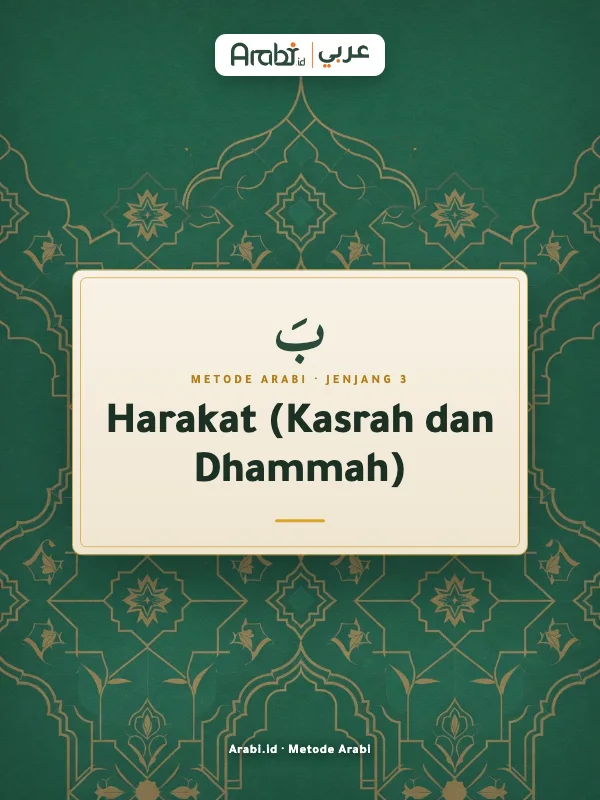
Harakat: Kasrah dan Dhammah
Real material
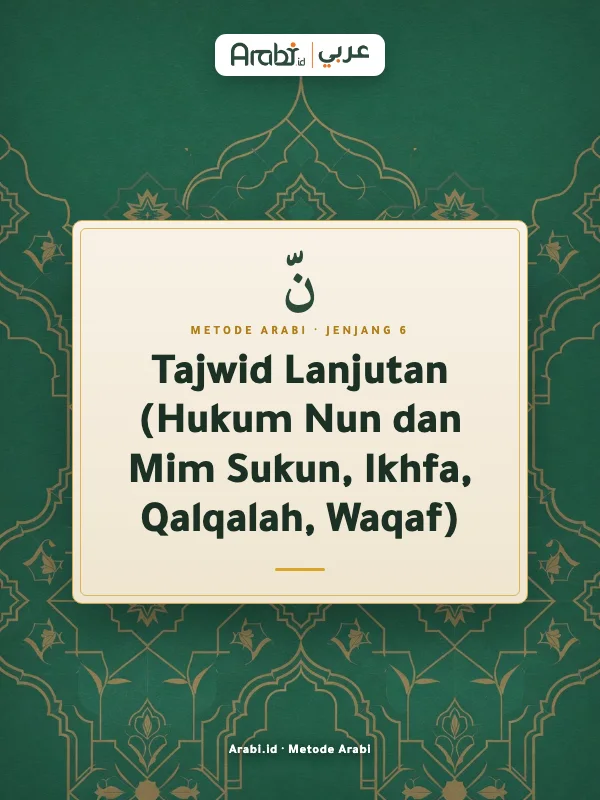
Tajwid Lanjutan: Nun dan Mim Sukun
Real material
Materials are matched to the level and ability of each student.
Tell us how far the student has come in learning the letters and the learning time you would like, and the Arabi team will match a suitable ustadz or ustadzah. Serving children, students, adult learners, and seniors, at home or online. Free consultation via WhatsApp.